
2
Learn More
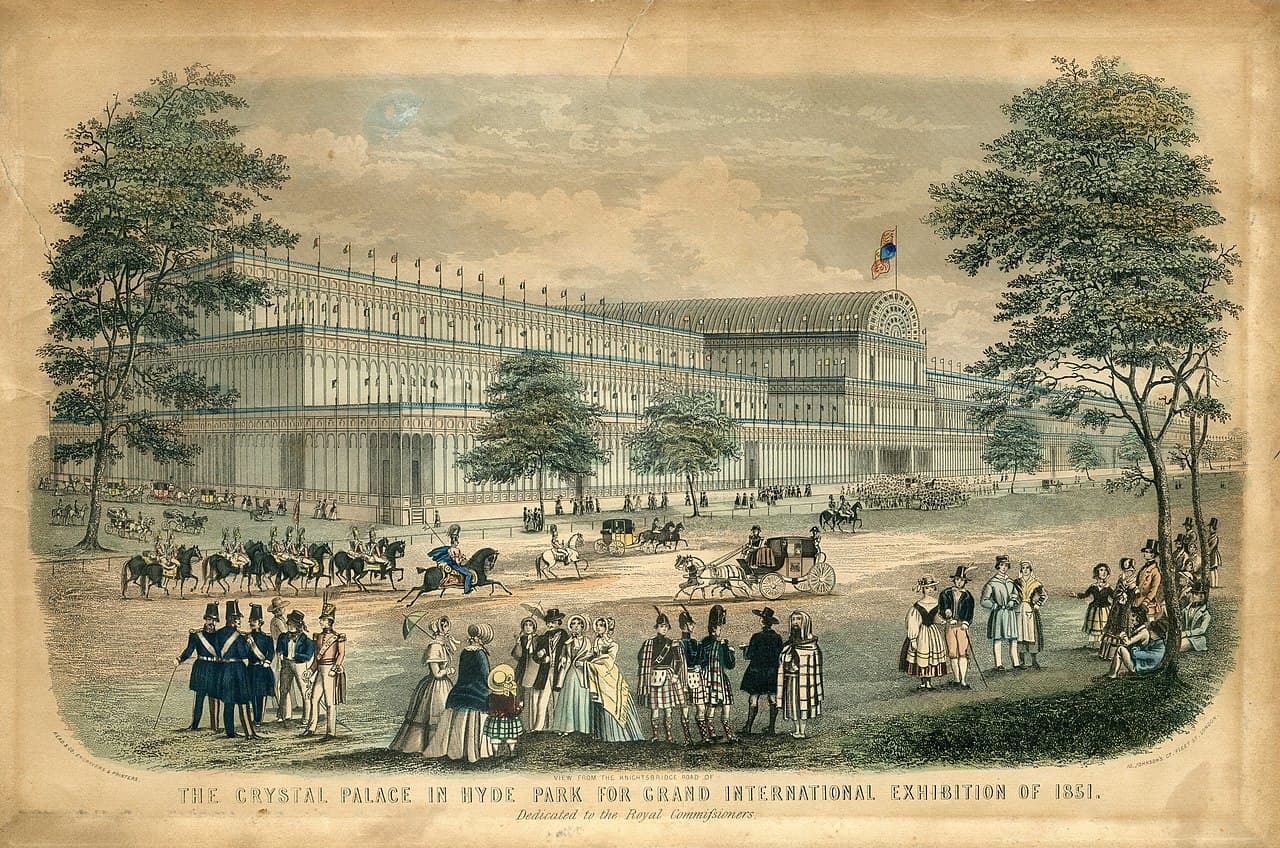
The Great (Review) Exhibition of the Works of Industry of All Nations, the first-ever international World's Fair, was held in London's Hyde Park from May to October 1851. The event was the brainchild of Queen Victoria's husband, Prince Albert, and was designed to showcase Britain's industrial, cultural, and military superiority. To house the more than 100,000 objects from 14,000 exhibitors, a revolutionary structure of cast iron and glass was built in just nine months. This enormous building, nicknamed the "Crystal Palace" by a satirical magazine, was a marvel of engineering, large enough to enclose several of Hyde Park's mature elm trees.
The fair was a spectacular success, attracting over six million visitors—equivalent to a third of the entire population of Britain at the time. Attendees from all social classes marveled at the international exhibits, which were divided into categories of raw materials, machinery, manufactures, and fine arts. Displays ranged from the Koh-i-Noor diamond to early telegraphs and the world's first public flush toilets, which were so popular that the phrase "to spend a penny" originated from their one-penny usage fee.
The legacy of the Great Exhibition had a lasting impact. The event generated a massive profit of £186,000, which was used to found a new cultural quarter in London. This fund led to the establishment of several institutions, including what would become the Victoria and Albert Museum, the Science Museum, and the Natural History Museum. After the fair, the Crystal Palace itself was dismantled and rebuilt in an enlarged form in South London, where it stood until it was destroyed by fire in 1936.
More Other Trivia Questions
20
How long is one lap of the Indianapolis motor speedway?
20What is the name of the five-dice game where players try to create different combinations similar to poker hands?
20A number of years ago, what product was advertised by means of the slogan, "I can't believe I ate the whole thing" ?
20Most people have 20 of these, but in 1921 a boy born in England had 29 of them. What were they?
20What is the name of the grand prize given at the Cannes film festival?
20The Wright brothers successfully flew an airplane in 1903 in what North Carolina location?