
82
Learn More
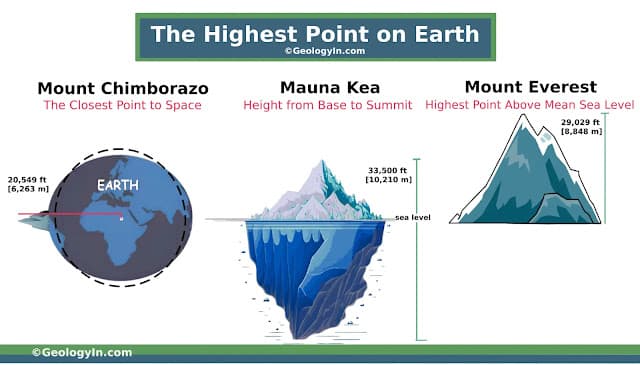
The distinction of the "highest" mountain is not as straightforward as it may seem. While Mount Everest reigns supreme in terms of elevation above sea level, Ecuador's Chimborazo holds the title for the farthest point from the Earth's center. This geographical curiosity is a direct result of our planet's shape. The Earth is not a perfect sphere but an oblate spheroid, meaning it bulges at the equator and is slightly flattened at the poles. This bulge is caused by the centrifugal force created by the Earth's rotation. As the Earth spins, areas along the equator are moving faster, which creates an outward force, causing the planet to be wider at its midline.
This equatorial bulge means that sea level itself is farther from the Earth's center at the equator than it is at the poles. Mount Chimborazo, being very close to the equator (just one degree south), gets a significant boost from this phenomenon. Even though its elevation above sea level is 6,263 meters, its summit is approximately 2,168 meters farther from the Earth's center than the summit of Mount Everest. This makes the peak of Chimborazo the closest point on Earth to the sun.
Historically, the true shape of the Earth was a subject of great scientific inquiry. In the 18th century, a French Geodesic Mission traveled to Ecuador to conduct measurements that ultimately helped prove the Earth is an oblate spheroid. For a considerable time, Chimborazo was even believed to be the highest mountain in the world in terms of elevation. It wasn't until the 19th century that Mount Everest's greater height above sea level was established. The first successful ascent of Chimborazo was achieved in 1880 by Edward Whymper.