
84
Learn More
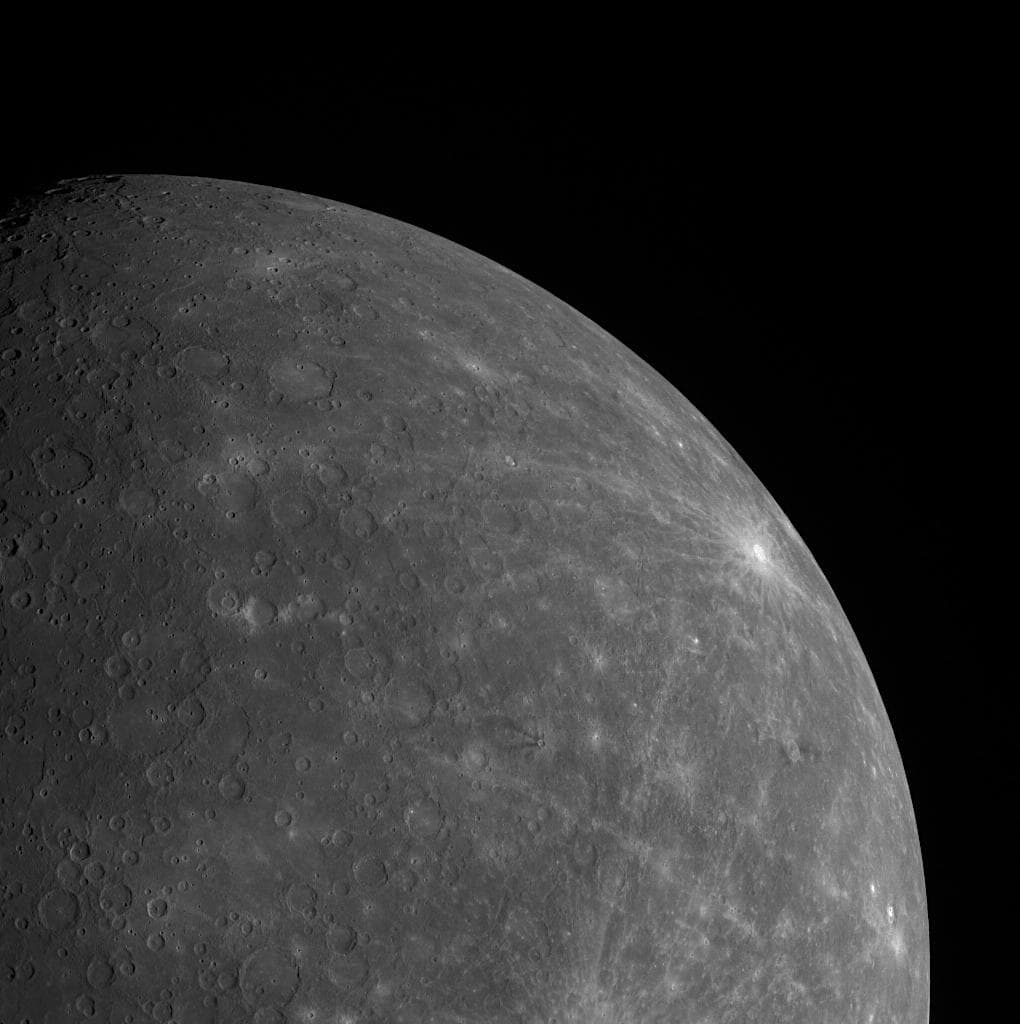
While proximity to a star is a major factor in a planet's temperature, the composition of its atmosphere can be even more influential. This is perfectly illustrated by the fact that Venus, the second planet from the Sun, is significantly hotter than Mercury, the first. Mercury lacks a substantial atmosphere, meaning it has no "blanket" to trap the immense solar heat it receives. Consequently, its surface temperature fluctuates dramatically, soaring to 430 degrees Celsius on the sunlit side and plummeting to a frigid -180 degrees Celsius at night.
Venus, by contrast, is shrouded in a dense atmosphere composed of 96.5% carbon dioxide, with clouds of sulfuric acid. This atmosphere is about 93 times more massive than Earth's, creating a surface pressure equivalent to being 900 meters underwater. This thick, carbon-dioxide-rich envelope creates a runaway greenhouse effect. While the clouds reflect a significant amount of sunlight, the solar energy that does penetrate is absorbed by the surface and re-radiated as heat. The dense atmosphere traps this outgoing infrared radiation, preventing it from escaping into space and leading to the extreme and stable surface temperature of around 465 degrees Celsius, hot enough to melt lead.
The discovery of Venus's scorching surface temperature in the late 1950s and its confirmation by early space probes like Mariner 2 in 1962, came as a surprise to scientists who once believed Venus could be a tropical paradise. This understanding of Venus's climate evolution serves as a powerful example of the profound impact a greenhouse effect can have on a planet. It is believed that Venus may have once had oceans, but as the Sun's luminosity increased, a runaway greenhouse effect was triggered, boiling them away and leading to the current inhospitable conditions. This process involved water vapor, a potent greenhouse gas, further amplifying the heating until the water molecules were broken down by sunlight and lost to space.
Related Weird Facts
83
83
81
81
80
80