
72
Learn More
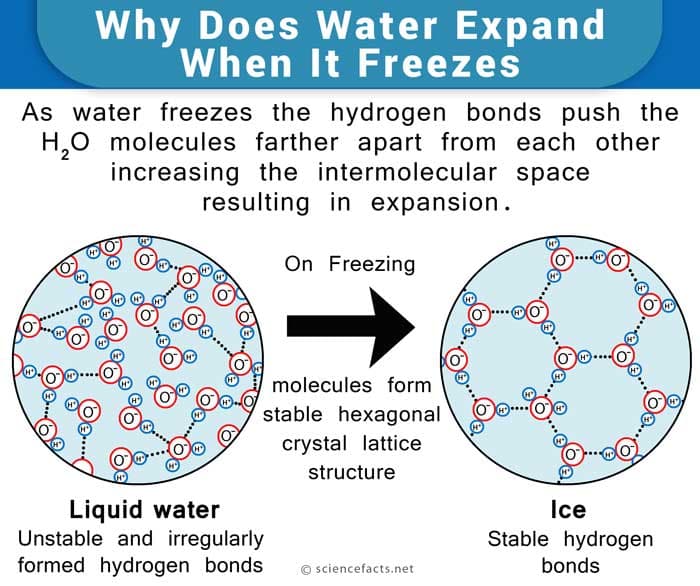
The peculiar behavior of water as it solidifies is a direct result of its molecular structure. A water molecule consists of one oxygen atom and two hydrogen atoms, creating a shape that is slightly asymmetrical. This asymmetry leads to a weak attraction, known as a hydrogen bond, between the hydrogen atoms of one molecule and the oxygen atoms of its neighbors. As water cools and approaches its freezing point, these hydrogen bonds begin to assert themselves, pushing the molecules into a highly organized and open crystalline structure. This hexagonal lattice takes up about 9% more space than the more disorderly arrangement of molecules in liquid water, which is why the solid form, ice, is less dense.
This expansion upon freezing has profound implications for life on Earth. Because ice is less dense than liquid water, it floats on the surface of lakes, rivers, and oceans. This layer of surface ice acts as an insulating blanket, protecting the aquatic life in the colder water below from the frigid air temperatures of winter. If water were to behave like most other substances and become denser upon freezing, ice would sink. Consequently, bodies of water would freeze from the bottom up, a process that would be catastrophic for the vast majority of aquatic ecosystems. While a few other elements like silicon, gallium, and bismuth also expand when they freeze, water is the only common one to do so.
Related Weird Facts
83
83
82
82
81
75