
73
Learn More
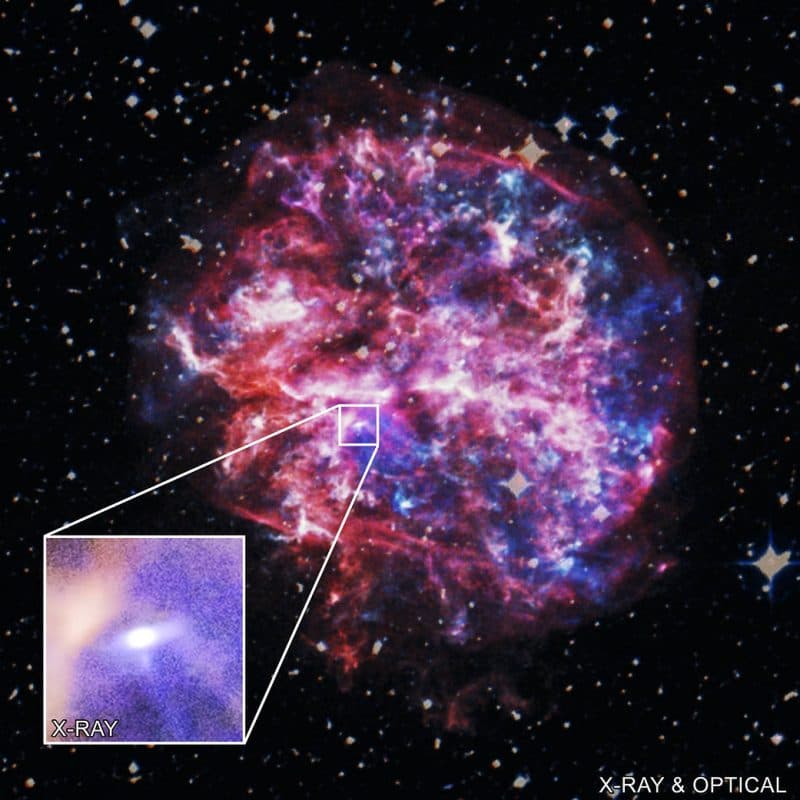
The immense weight of neutron star material stems from the violent death of a massive star. When a star many times the mass of our sun runs out of fuel, its core collapses catastrophically, triggering a supernova explosion. While the outer layers are blasted into space, the core continues to collapse under its own immense gravity. This gravitational force is so powerful that it overcomes the forces that keep atoms apart, forcing protons and electrons to merge into neutrons. This process packs an incredible amount of mass into a very small space, creating an object with a density comparable to that of an atomic nucleus.
A neutron star can have a mass greater than that of our entire sun but be only about 12 miles (20 kilometers) in diameter. Imagine the sun, which has a diameter of about 864,000 miles, being compressed into the size of a city. This extreme compression is what gives a neutron star its mind-boggling density. The material is so tightly packed that there is virtually no empty space between the neutrons. It is this incredible density that accounts for the seemingly impossible weight of such a small amount of its material.
These stellar remnants are among the most extreme objects in the universe, second only in density to black holes. The gravitational pull on the surface of a neutron star is hundreds of billions of times stronger than on Earth. First proposed in the 1930s, their existence wasn't confirmed until the discovery of pulsars in 1967, which were later identified as rapidly rotating neutron stars. These objects serve as natural laboratories for studying physics under conditions that cannot be replicated on Earth.